



13 November, 2025
DNC’S RETURN-TO-OFFICE MANDATE IGNITES TENSIONS WITH STAFF UNION
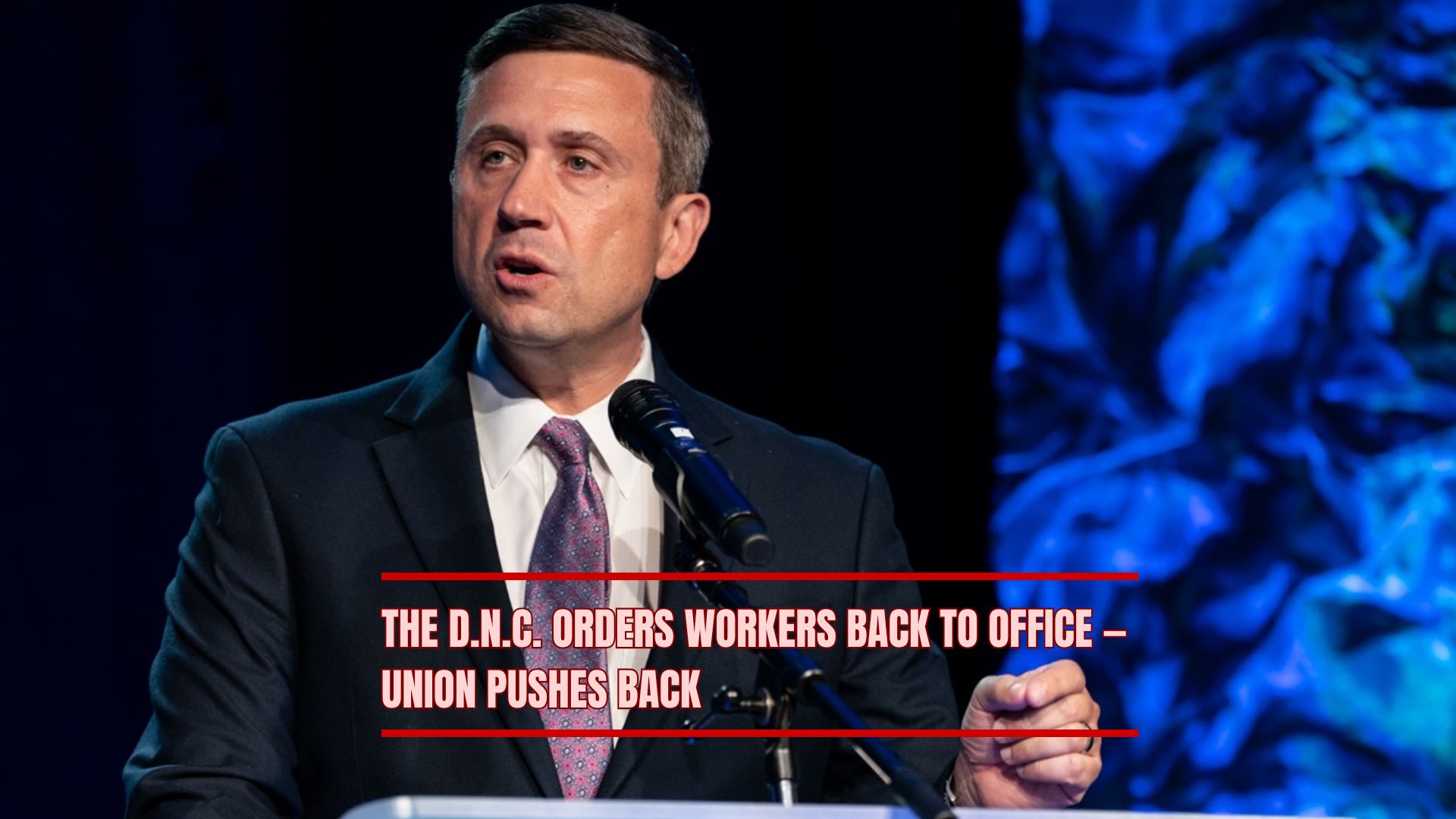
In a move that has reignited the national debate over remote work, the Democratic National Committee (DNC) announced that its Washington-area employees must return to the office five days a week, ending the hybrid arrangements that had been in place since the pandemic.
The decision, revealed during a virtual all-staff meeting earlier this week, was met with an immediate and visceral reaction. As the announcement was made, thumbs-down emojis flooded the screen, symbolizing widespread disapproval from DNC staffers who felt blindsided and disregarded.
Within hours, the DNC Union issued a sharply worded statement condemning the policy as “callous and counterproductive,” arguing that it undermines employee morale, threatens work-life balance, and contradicts the values the Democratic Party claims to champion.
UNION LABELS DECISION AS “CALLOUS AND UNNECESSARY”
In its official response, the DNC Union — which represents dozens of committee employees — said management’s abrupt decision violated the spirit of collaboration and transparency promised when the workplace was unionized.
“We were not consulted, and our input was not sought,” the union said. “This unilateral decision is not just about where we work; it’s about how the DNC values its workers. To demand a full-time return without negotiation is callous.”
Union representatives emphasized that staff productivity had remained strong under hybrid and remote models. They cited data showing increased flexibility had improved retention and reduced burnout — outcomes they say are critical to the DNC’s long-term mission.
The union added that forcing workers back to physical offices in Washington, D.C., amid high living costs and long commutes “disproportionately harms lower-wage staff and working parents,” many of whom have built their lives around flexible arrangements introduced during the pandemic.
DNC LEADERSHIP DEFENDS THE DECISION
In response to the criticism, DNC officials defended the mandate, saying the organization’s work is inherently collaborative and benefits from in-person interaction.
A DNC spokesperson explained that the committee’s mission — particularly heading into a high-stakes 2026 election cycle — requires “the energy, creativity, and synergy that come from working together under one roof.”
“Our party’s success depends on teamwork,” said one senior DNC official. “We believe returning to the office full-time will strengthen coordination and improve communication at a critical moment.”
The spokesperson added that exceptions would be considered on a case-by-case basis for employees with medical or family circumstances. However, critics say the rollout’s tone and timing — coming just as staffers begin preparing for a busy campaign year — showed “a lack of empathy and planning.”
A CLASH BETWEEN VALUES AND PRACTICES
The internal conflict at the DNC underscores a broader contradiction many organizations face: reconciling pro-worker values with management practices that often mirror corporate America’s most unpopular trends.
The Democratic Party has long positioned itself as a champion of labor rights, workplace flexibility, and economic fairness. Yet, by mandating a full-time in-office policy without negotiation, staffers argue the DNC risks appearing hypocritical.
“You can’t campaign on supporting unions and working families while ignoring your own union’s concerns,” one anonymous DNC employee told reporters. “It’s a terrible look — and it’s demoralizing.”
The optics are particularly sensitive for a party that relies heavily on the support of organized labor. The DNC formally recognized its staff union in 2022, following a wave of labor activity across Democratic-aligned organizations. Since then, other political committees and advocacy groups — including those linked to President Biden’s re-election efforts — have adopted more flexible workplace arrangements.
THE LARGER DEBATE: RETURN TO OFFICE VS. FLEXIBILITY
The DNC’s mandate is part of a nationwide push among institutions — from corporations to government agencies — to bring workers back to physical offices. Proponents argue that in-person collaboration fosters innovation, accountability, and stronger team culture.
Critics, however, counter that these policies often ignore workers’ proven productivity at home and disregard the benefits of flexible schedules. For many employees, especially those with caregiving responsibilities or long commutes, remote work has been a lifeline.
Labor experts say the DNC’s decision could have broader implications for workplace trends in politics. If the DNC’s internal union decides to challenge the mandate formally — through grievance procedures or collective bargaining — it could set a precedent for how political organizations must negotiate return-to-office policies in the future.
UNION RESPONSE: CONSIDERING NEXT STEPS
Following the announcement, DNC Union members convened an emergency meeting to discuss potential responses. According to sources familiar with the discussion, options on the table include filing a formal grievance, demanding a good-faith negotiation, or launching a public pressure campaign aimed at reversing the mandate.
Union representatives emphasized that they are not opposed to in-person work altogether but want management to recognize “the proven value of flexibility.”
“Our staff has shown time and again that we can deliver results from wherever we work,” the union said. “We’re asking for respect, not special treatment.”
Some members have proposed a hybrid compromise — three days in the office, two days remote — which mirrors the model adopted by other Democratic-affiliated organizations like the Democratic Congressional Campaign Committee (DCCC) and various advocacy groups in Washington.
POLITICAL FALLOUT AND PUBLIC REACTION
The controversy quickly spilled into political circles and social media, where many progressive commentators criticized the DNC’s stance.
“For a party that champions workers’ rights, this move feels tone-deaf,” wrote one prominent labor journalist on X (formerly Twitter).
Several union-friendly lawmakers also weighed in privately, with some aides expressing concern that the situation could become an unnecessary distraction heading into an election year.
Meanwhile, centrist voices within the party defended the policy, arguing that campaign coordination and morale depend on “being physically together in moments of strategy and urgency.”
Still, the backlash highlights how remote work has become a generational and ideological flashpoint, not just a logistical issue. Younger, more digitally fluent workers overwhelmingly support flexibility, while older leaders tend to favor traditional office culture.
A TEST OF DEMOCRATIC VALUES
As the DNC prepares for a crucial election cycle, the dispute offers a revealing test of how the party’s internal culture aligns with its public message.
If the committee moves forward without addressing worker concerns, it risks alienating not only its own staff but also a key constituency — the labor movement — that has historically powered Democratic campaigns.
Conversely, if leadership chooses to engage with the union and revise the policy, it could strengthen the party’s credibility on workplace fairness and solidarity.
For now, though, tensions remain high inside the DNC headquarters, where staff morale has taken a noticeable hit.
“It’s hard to rally the country around fairness,” one employee said, “when you can’t find it in your own office.”
CONCLUSION: UNITY BEGINS AT HOME
The Democratic National Committee’s return-to-office order was intended to promote teamwork, but it has instead revealed deep internal divisions over respect, autonomy, and modern workplace values.
Whether the DNC leadership listens to its unionized employees may determine not just office attendance — but also how convincingly the party can campaign on the promise of supporting American workers.
As one staffer put it succinctly:
“If Democrats can’t model the future of work, who can?”