%20(4).png)


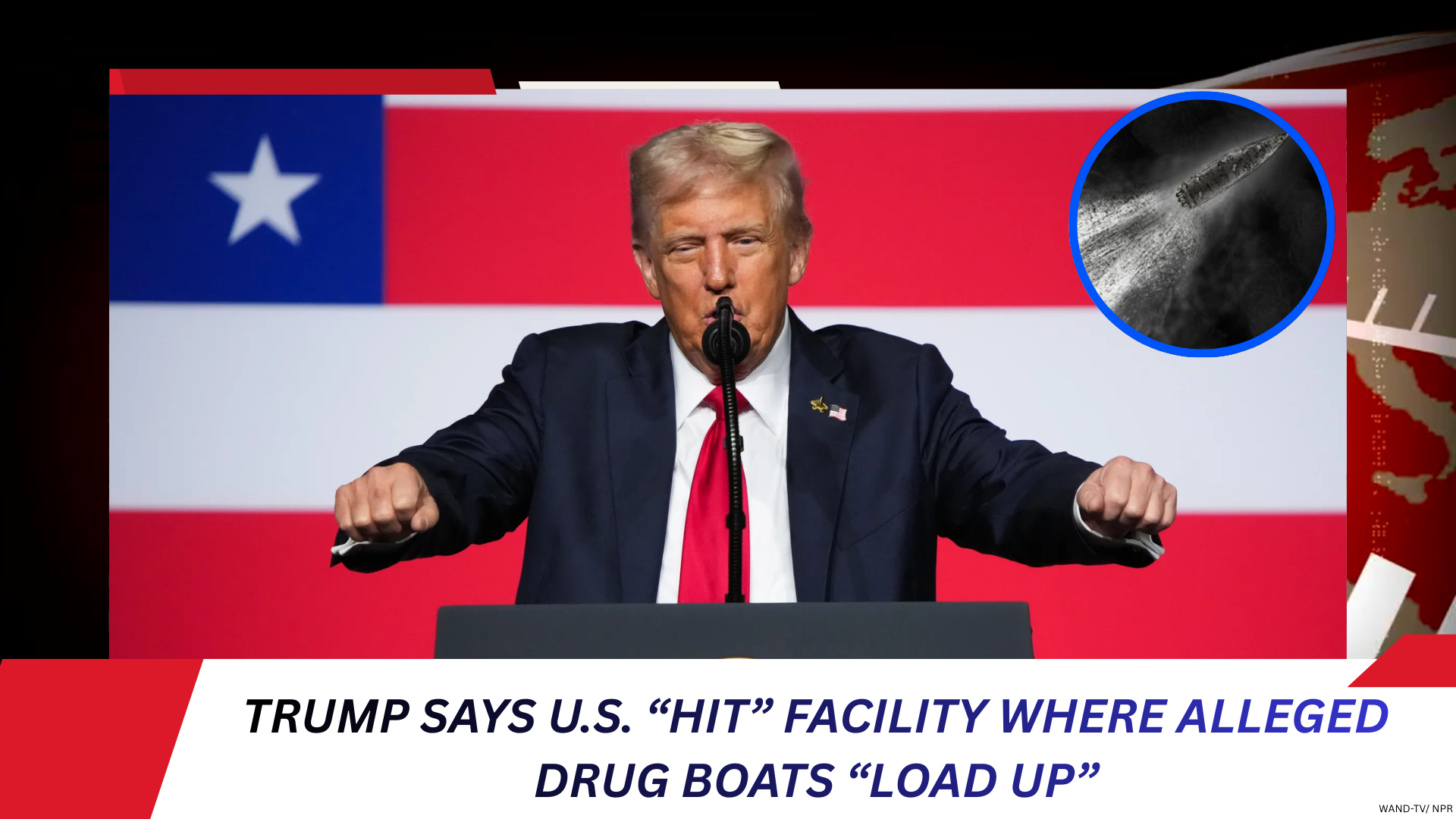


Former U.S. President Donald Trump has stated that the United States carried out a strike on a facility he described as a location where boats are allegedly loaded with illegal drugs, a claim that has sparked international attention and uncertainty due to the lack of official confirmation or detailed evidence.
Speaking publicly, Trump said the U.S. “hit” a dock or operational site that he alleged was used by drug traffickers to prepare maritime shipments. According to his remarks, the facility played a role in the movement of narcotics by sea, and its destruction was part of broader efforts to combat international drug trafficking networks. He characterized the incident as decisive and effective, suggesting that the strike caused a significant explosion and disruption to illicit operations.
However, Trump did not disclose the exact location of the facility, the timing of the strike, or the specific U.S. agency responsible for carrying it out. He also did not provide independent verification or evidence to support the claim. As a result, questions remain about whether the strike occurred as described, what legal authority governed the action, and how it fits into existing U.S. counter-narcotics policy.
U.S. government agencies, including the Pentagon and other national security bodies, have not publicly confirmed Trump’s statement. The absence of official acknowledgment has fueled speculation about whether the operation was covert, exaggerated, or still classified. In similar past cases, U.S. officials have often delayed confirmation of sensitive military or intelligence operations, particularly when they involve foreign territory.
The alleged strike reportedly targeted a coastal or dockside facility, which Trump suggested was used as a staging point for drug boats before they entered international waters. Maritime drug trafficking remains a major concern for U.S. authorities, particularly in regions where weak enforcement and corruption enable organized criminal networks to operate with relative freedom. Drug shipments by sea are frequently used to transport large quantities of narcotics toward North America and other global markets.
Trump’s comments come amid renewed political rhetoric emphasizing aggressive action against drug cartels and transnational criminal organizations. Throughout his political career, he has repeatedly framed drug trafficking as a national security threat, often linking it to border control, immigration, and regional instability. His statement appears consistent with that messaging, portraying direct action as necessary to disrupt supply chains rather than focusing solely on interdiction at sea.
Internationally, the claim has drawn attention because of its potential implications for sovereignty and regional stability. If the strike occurred within another country’s territory without public consent or acknowledgment, it could raise concerns under international law. Military actions conducted without transparency or multilateral agreement can heighten diplomatic tensions, particularly in politically sensitive regions.
At the same time, some analysts caution that Trump’s remarks should be interpreted carefully. Without confirmation from U.S. or foreign authorities, it remains unclear whether the facility was actually destroyed, whether it was linked to drug trafficking, or whether the action represents a broader policy shift. In past instances, claims of decisive action against criminal infrastructure have sometimes proven to be overstated or symbolic rather than operationally transformative.
Drug trafficking networks are highly adaptable, and the destruction of a single facility rarely results in long-term disruption unless followed by sustained enforcement efforts. Experts note that while strikes or raids can temporarily slow operations, criminal groups often relocate or rebuild quickly. As a result, counter-narcotics strategies typically rely on a combination of intelligence-sharing, financial tracking, law enforcement cooperation, and maritime patrols rather than isolated attacks.
The lack of details surrounding Trump’s claim has also made it difficult to assess potential humanitarian or environmental consequences. Strikes on coastal infrastructure can carry risks, including damage to civilian areas, port facilities, or local livelihoods. Without official statements or assessments, it is not possible to determine whether any such impacts occurred.
Politically, the statement has reignited debate over the scope of U.S. power in combating international crime. Supporters argue that decisive action against drug infrastructure is necessary to protect public health and national security. Critics, however, warn that unilateral actions may undermine international cooperation and create precedents that complicate diplomatic relationships.
As of now, no independent verification has emerged to confirm the strike or its aftermath. Foreign governments that might be connected to the alleged location have not publicly acknowledged an attack or reported damage consistent with Trump’s description. This silence further complicates efforts to evaluate the credibility and significance of the claim.
Until more information becomes available, Trump’s statement remains an assertion rather than a confirmed event. Whether it reflects a real operation, a classified action, or political rhetoric, it underscores ongoing tensions around drug enforcement, transparency, and the use of force beyond U.S. borders.