%20(4).png)


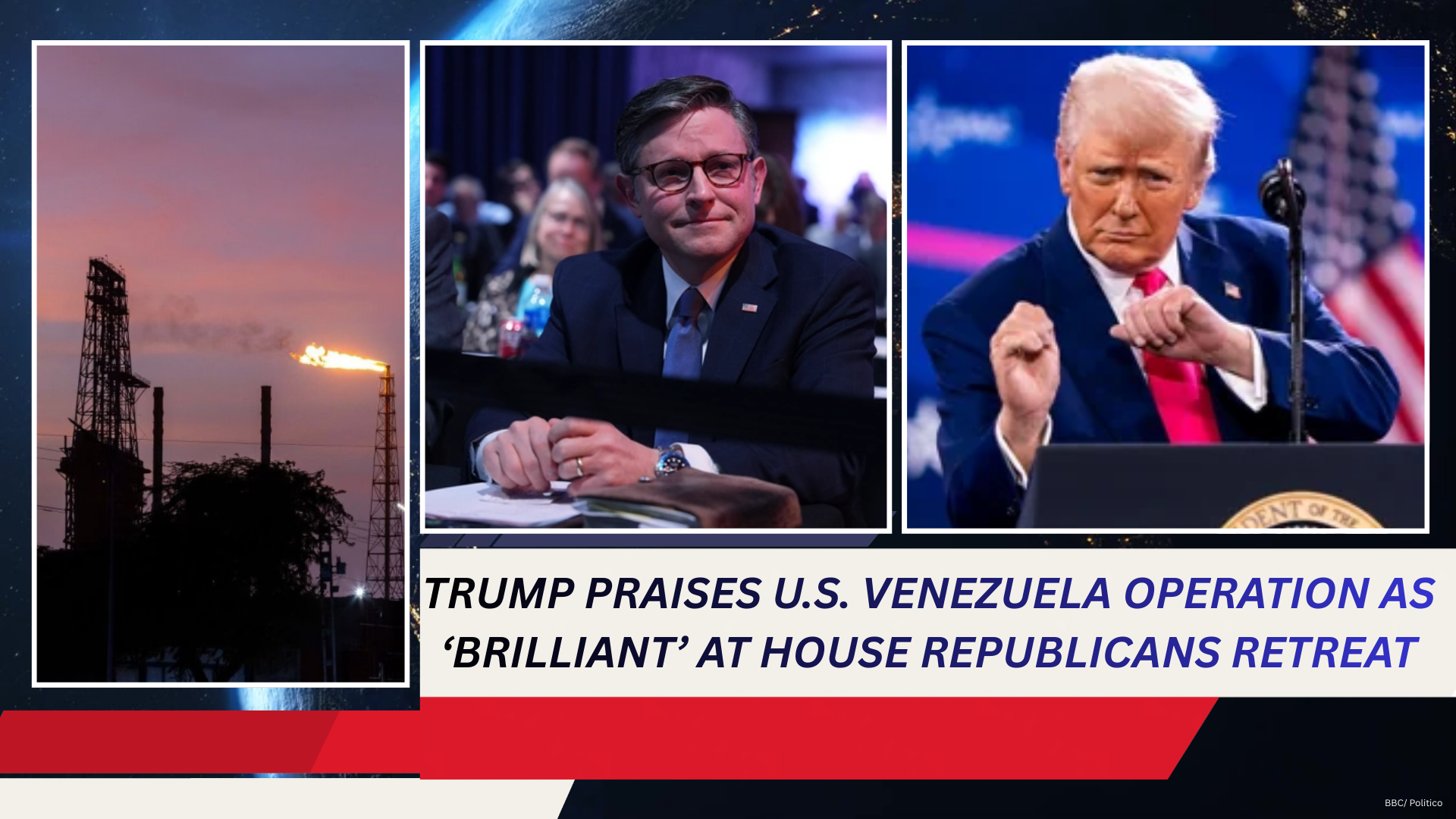


At a retreat for House Republicans, President Donald Trump described the recent U.S. military operation in Venezuela that resulted in the capture of Nicolás Maduro as “brilliant,” emphasizing its precision, planning, and lack of American casualties. His remarks came as part of a broader address aimed at rallying party members ahead of upcoming legislative sessions and potential midterm elections. While the president’s tone was celebratory, the statements underscore both the political and strategic dimensions of the operation.
Trump highlighted the complexity of the operation, noting that it involved coordination across multiple branches of the military and intelligence services. He framed the capture of Maduro as a demonstration of American capability and decisiveness in the Western Hemisphere, portraying it as a case study in projecting power without escalation or loss of life. The president’s remarks sought to reassure supporters that U.S. forces can act efficiently when national interests are at stake.
The operation itself, conducted in the early days of the year, has been widely reported as unprecedented in its direct removal of a sitting foreign leader. Trump reiterated his view that the U.S. is now in a position to influence the management of Venezuela’s oil resources and political trajectory, framing this as both a strategic victory and a potential economic gain. The president’s comments also suggested that continued attention to Venezuela will remain a priority for his administration, blending foreign policy with domestic messaging for his political base.
Reactions among Republicans at the retreat were largely supportive, reflecting a party alignment with Trump’s approach to demonstrating American strength abroad. Many attendees praised the operation as an example of what they see as decisive leadership in contrast to perceived hesitancy by previous administrations. Some members highlighted the operation’s timing and its potential effect on upcoming elections, noting that foreign policy achievements can have domestic political resonance, particularly among voters attentive to national security and energy independence.
However, Trump’s characterization of the operation has drawn scrutiny outside his party. International observers and legal experts have raised questions about the legality of removing a sitting head of state by force, with some calling it a potential violation of international law. Critics argue that celebrating such an operation risks normalizing unilateral interventions, potentially destabilizing diplomatic norms. These concerns are tempered by the fact that the operation, at least according to U.S. officials, avoided direct conflict and casualties, a point Trump emphasized repeatedly.
Strategically, the operation signals a continuation of a U.S. policy approach that prioritizes assertive measures to influence neighboring regions. Venezuela’s oil reserves, long a point of contention in global markets, are central to the administration’s framing of the operation as both a geopolitical and economic success. By linking military action with energy policy, Trump reinforced a narrative that American strength abroad can translate into tangible domestic benefits.
The president also used his remarks to address domestic political strategy. By presenting the operation as a “brilliant” success, he sought to consolidate his base and signal leadership qualities ahead of internal party contests and the next congressional cycle. The retreat setting allowed Trump to emphasize personal agency and decisiveness, portraying himself as the architect of a foreign policy achievement that traditional institutions had been unable to deliver.
Yet, the broader international reaction remains mixed. Some U.S. allies have cautiously welcomed the removal of Maduro, citing frustration with his governance and corruption, but others have criticized the unilateral nature of the operation. Latin American leaders, in particular, have expressed concern about precedent and sovereignty, emphasizing that even in cases of widespread condemnation of a regime, removal by external military force is fraught with legal and ethical challenges.
Trump’s remarks also underscore a central tension in modern American politics: the blending of foreign policy actions with domestic political messaging. By praising the operation publicly in a partisan setting, the president framed the success not solely as a strategic or humanitarian act but as a political narrative aimed at consolidating influence within his party. Analysts note that while this approach energizes supporters, it can complicate relations with allies who may prefer measured, institutionally coordinated messaging in sensitive international matters.
In conclusion, Trump’s characterization of the U.S. Venezuela operation as “brilliant” serves multiple purposes: it celebrates an unprecedented military and intelligence achievement, reinforces a narrative of decisiveness in foreign policy, and strengthens political capital within his party. The operation, while tactically successful, continues to raise questions about legality, sovereignty, and long-term stability in the region. For now, the remarks underscore the administration’s focus on combining strategic action abroad with messaging that resonates at home, a duality that is shaping both American foreign policy and domestic political dynamics in the months ahead.